Why oak needs specific care
Solid oak has an open-grain structure. Unlike painted or lacquered surfaces, oiled and waxed oak absorbs liquids directly into its pores. This makes it responsive to treatment — and vulnerable to the wrong one. Household cleaners formulated for tiles or glass often contain bleach, ammonia or alcohol-based solvents. Any of these will strip protective finishes from oak, dry out the grain and, over repeated use, cause surface greying and cracking.
In Polish homes, the additional challenge is seasonal humidity variation. Winter heating reduces indoor humidity, which dries wood and opens the grain further. Summer months reverse this. A cleaning routine that ignores this cycle will accelerate surface wear even when the correct products are used.
Products and tools to avoid
The following should not be used on untreated, oiled or waxed solid oak:
- Bleach-based cleaners — lighten and permanently discolour oak, especially in the tannin-rich grain lines.
- Ammonia-based glass cleaners — dissolve wax and oil finishes rapidly.
- Silicone furniture sprays — build up a film that resists future oil penetration and causes streaking over time.
- Abrasive scrubbing pads — scratch the surface and remove finish unevenly.
- Excess water — any water left standing on oak for more than a few minutes will raise the grain and leave white or dark rings depending on the finish.
- Steam cleaning — forces moisture deep into the grain, particularly harmful to mortise-and-tenon joints.
Note on lacquered oak: Factory-lacquered oak (common in flat-pack furniture sold in Poland under several retail brands) tolerates slightly more moisture than oiled surfaces, but still reacts badly to bleach and abrasive cleaners. When in doubt about the finish, test any new cleaner in an inconspicuous area and wait 24 hours.
Routine dry dusting
Most of the cleaning a solid oak piece needs is dry removal of dust and fine debris. A microfibre cloth is the most practical tool — it picks up particles without scratching and does not require any cleaning agent. Cotton cloths are acceptable but tend to leave lint on heavily grained surfaces.
Always dust with the grain, not across it. Crossing the grain direction with a cloth catches on ridges and can lift fine slivers of wood fibre on older or weathered pieces. For carved elements — legs, chair backs, decorative frames — a soft natural-bristle brush clears dust from recesses without the friction of a cloth.
Frequency depends on placement. A dining table used daily will need dusting two to three times a week. A bookshelf in a low-traffic room can be done once a week or less.
Wet cleaning — when and how
Wet cleaning should be infrequent and carried out only when dry methods are insufficient. The correct approach is a wrung-out cloth barely damp with clean water, or water with a small quantity of pure castile soap (a few drops per litre). Wring the cloth so that pressing it leaves no visible moisture on a glass surface before applying it to the oak.
Step-by-step process
- Remove all loose dust first with a dry microfibre cloth.
- Prepare the cleaning solution — warm water only, or water with a few drops of castile soap.
- Wring the cloth thoroughly until it feels just barely damp.
- Wipe in the direction of the grain with light, even pressure.
- Follow immediately with a dry cloth to remove any remaining moisture.
- Do not close drawers or place objects back on the surface until it has dried completely — typically 20 to 30 minutes.
Removing specific marks
Water rings
White rings on oiled or waxed surfaces indicate moisture trapped beneath the wax layer, not damage to the wood itself. The standard approach is to apply a small amount of furniture wax or olive oil to the ring, leave it for an hour, then buff with a dry cloth in circular motions. For persistent rings, very fine steel wool (grade 0000) lightly rubbed with the grain will open the wax layer and allow re-oiling.
Dark rings indicate moisture that reached the wood. These require sanding and re-finishing and are covered in the repair article.
Grease and cooking residue
Kitchen oak pieces accumulate grease over time. A cloth dampened with a solution of warm water and a small amount of washing-up liquid (no more than a few drops per 500 ml) will cut through surface grease without damaging an oiled finish if used sparingly and followed immediately by a dry cloth. Allow to dry, then apply a thin coat of furniture oil.
Ink and marker pen
Fresh ink can sometimes be lifted with a cloth barely dampened with isopropyl alcohol (70%), working from the edges of the mark inward to prevent spreading. This will partially remove the protective finish in the treated area and require spot-oiling once dry. Do not use acetone, as this will strip all finish and begin dissolving the wood surface itself.
Seasonal care in the Polish climate
Indoor humidity in Poland drops significantly between October and March as central heating runs continuously. At relative humidity below 40%, solid oak will contract noticeably — small gaps appear between planks in tabletops, and joints may loosen. Placing a humidifier in rooms with significant oak furniture during heating season, targeting a humidity range of 45–55%, reduces this movement.
Before the heating season begins — typically September — is a useful time for a full surface inspection: check for dry or dull areas, apply a coat of furniture oil if the surface absorbs it immediately (a sign the oil layer has worn), and address any minor scratches before they deepen during the dry months.
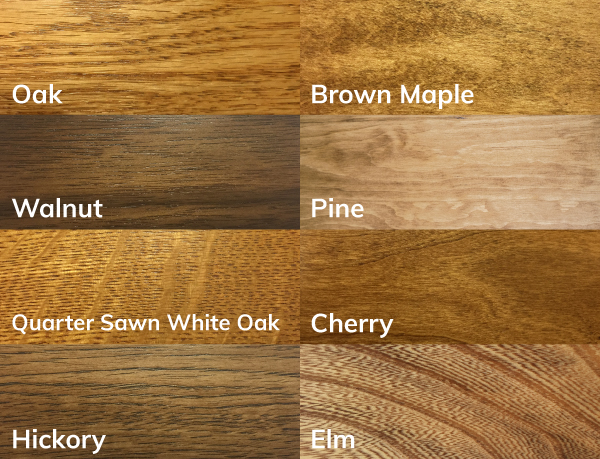
Image: Popular American Furniture Wood Types — Wikimedia Commons, public domain. Related reading: Wood finishing (Wikipedia).